• Only registered members can see all the forums - if you've received an invitation to join (it'll be on your My Summary page) please register NOW!

  • If you're looking for the LostCousins site please click the logo in the top left corner - these forums are for existing LostCousins members only.
  • This is the LostCousins Forum. If you were looking for the LostCousins website simply click the logo at the top left.
  • It's easier than ever before to check your entries from the 1881 Census - more details here

Ethnicity estimates

The Rhymer

LostCousins Member
I know that you, Peter, say that ethnicity estimates should be ignored, but I noticed recently that Ancestry have removed Normandy from my map and left only the tip of the Pas de Calais. Being truly British, i.e. with all four home nations in me, plus Scandinavian/Viking blood, I found it logical to have Normandy on my map; they were North men, too, before they came over with Duc Guillaume. So why has that region suddenly disappeared? Surely some Norman blood got into my make-up along the way?

And, while on the subject of DNA, who can find the argument which will convince my sister to take a test, please? First she didn't want her DNA "out there", now she "can't be bothered" - since I've told her how different our results could be.

She's helped me with family history, although she's not really interested in it, and come to different Archives with me in the past to help me find records. But if I make a discovery, like finding a Lord Mayor of Liverpool, albeit only for a year, among our direct ancestors, she doesn't seem very enthusiastic.

All ideas gratefully received :)
 
Last edited by a moderator:
There's no point puzzling over the maps that Ancestry or others use - they're not completely random, but they might as well be, for all the use they are. The key thing to remember is that you don't inherit DNA from all of your ancestors, nor do you inherit it in equal proportions. The chance that you inherited any DNA at all from any single ancestor who arrived in 1066 is about 1 in 3000.

The main advantage in your sister testing is that about half of her distant matches will be ones that aren't on your list. It isn't a particularly compelling argument, and I haven't even asked my sister to test.
 
The chance that you inherited any DNA at all from any single ancestor who arrived in 1066 is about 1 in 3000

I'm not thinking about one single Norman who came over in 1066; I'm thinking about their descendants and their descendants and so on ad infinitum. After all, we - as in every English person with local blood - are all descended from Norman royalty, aren't we, but we just can't prove it.
 
The main advantage in your sister testing is that about half of her distant matches will be ones that aren't on your list. It isn't a particularly compelling argument, and I haven't even asked my sister to test.

But you seem to have lots of relatives who have tested - and lots of matches. When I tested, the only person of the previous generation still alive was my aunt who did do the test, although I only managed to get hold of her results at the end of last year, and my sister is the only family I have left.

I once wrote to you asking how you worked out who was Parent One and who Parent Two, and you rather loftily replied "through your matches". I was crushed as no-one had matched to me so that wasn't a possibility; no-one seemed to be researching the same ancestors as I was. Now Ancestry offers me lots of matches, but none of them have trees :confused:
 
But you seem to have lots of relatives who have tested - and lots of matches. When I tested, the only person of the previous generation still alive was my aunt
None of the previous generation of my family tested - they all passed away before autosomal testing became available. But I paid for my two surviving 1st cousins and several 2nd and 3rd cousins to test, initially with FTDNA as Ancestry was not available in the UK.

I have fewer matches at Ancestry than almost anyone I know - only 12,274 as of today. But it's still plenty!
I once wrote to you asking how you worked out who was Parent One and who Parent Two, and you rather loftily replied "through your matches"
There isn't any other way of knowing which is which - what else I could have said? Even Ancestry don't know, which is why they leave it up to the person who tested.
I was crushed as no-one had matched to me so that wasn't a possibility; no-one seemed to be researching the same ancestors as I was. Now Ancestry offers me lots of matches, but none of them have trees
Perhaps Ancestry hadn't finished processing your results when you looked initially? It's not possible to have zero matches.

Or perhaps you only looked at 'Shared Ancestors' matches? If you hadn't uploaded your tree at that point, or if they hadn't had time to process it, there wouldn't have been any. These things don't happen instantly - processing DNA results is so computer-intensive that they only do it when they have spare capacity.
 
I once wrote to you asking how you worked out who was Parent One and who Parent Two, and you rather loftily replied "through your matches". I was crushed as no-one had matched to me so that wasn't a possibility; no-one seemed to be researching the same ancestors as I was. Now Ancestry offers me lots of matches, but none of them have trees :confused:

As example to working out which parent is "Parent One" and "Parent Two" through your matches, I'll give you an example. My mother's ancestry is pretty much 50-50 English and Welsh, and both of her parents had parentage that was 50-50 English/Welsh; so there are no easy ways to determine which parent is which (like my paternal grandmother, whose father was Scottish/Irish and mother was Jewish/English and so you immediately know that the side with the Jewish ancestry is her mother's).

However, I have been able to identify close matches on both sides of my mother's tree in her DNA matches (through their trees and contact with them) - 4 paternal second cousins and a similar number of maternal second cousins. Therefore I could then "help" Ancestry by marking these as "maternal side" and "paternal side" and from now on, Ancestry does it for me.

As for the numbers of results, that will change as Ancestry processes things. Like Peter says, there is no chance you have "no matches" and it may take a little bit of time for the system to catch up. The lowest results I have in those that I manage is just over 21,000 matches.
 
As example to working out which parent is "Parent One" and "Parent Two" through your matches, I'll give you an example
Ethnicity is an unreliable guide in many cases, and it certainly isn't necessary to take the risk.

Follow the advice in the Masterclass and you can't go wrong. All you need is a few matches with someone you know, or know of, or who shares one of your ancestors. Unless you are an adoptee, or both your parents were adoptees, you will have dozens of such matches, and provide you have attached a tree to your DNA results Ancestry will identify some of them for you (as Shared Ancestors matches).
Therefore I could then "help" Ancestry by marking these as "maternal side" and "paternal side" and from now on, Ancestry does it for me.
I don't believe that's how it works. Once you know which is parent 1 and which is parent 2 you can tell Ancestry, as a result of which they will use 'maternal' and 'paternal' in their SideView predictions. But unless they've changed their system, they won't do it simply because you confirm how you are related to some identifiable cousins.
 
Therefore I could then "help" Ancestry by marking these as "maternal side" and "paternal side" and from now on, Ancestry does it for me.
My matches show as parent 1 or parent 2 unless I change them individually. Although I've been able to identify from my matches which parents is which, and have identified my known matches as maternal or paternal, it doesn't seem to affect how new matches appear.
 
My matches show as parent 1 or parent 2 unless I change them individually. Although I've been able to identify from my matches which parents is which, and have identified my known matches as maternal or paternal, it doesn't seem to affect how new matches appear.
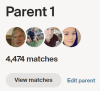
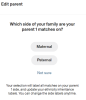
To let Ancestry which parent is which on a global basis click Edit parent. The dialogue appears at the far right on my screen, easy to miss.

upload_2024-5-13_11-26-3.png

upload_2024-5-13_11-27-9.png
 
The dialogue appears at the far right on my screen, easy to miss.
Thank you. I can't find anything on the far right of a screen, but if I click to view my matches by parent, there are edit parent links towards the LH side. It must be newish as it wasn't there last time I looked at that page.
 
Thank you. I can't find anything on the far right of a screen, but if I click to view my matches by parent, there are edit parent links towards the LH side. It must be newish as it wasn't there last time I looked at that page.
That's right - the Edit parent link is near the left of the screen, the pop-out is at the far right (so far right that I missed the first three times I clicked the link).

The functionality has always been there, but this particular link may well be new. I generally find that any screenshots in 'how to' articles about Ancestry DNA are out of date within a few months, though the changes are usually fairly minor.
 
Perhaps Ancestry hadn't finished processing your results when you looked initially? It's not possible to have zero matches.

Or perhaps you only looked at 'Shared Ancestors' matches? If you hadn't uploaded your tree at that point, or if they hadn't had time to process it, there wouldn't have been any. These things don't happen instantly - processing DNA results is so computer-intensive that they only do it when they have spare capacity.

Peter, I'm afraid I didn't explain myself at all well back in post #4. I have only ever had a tree on Ancestry (oh, apart from one on Genes Reunited right back in the mists of time) so they put my results straight on to my tree and did indeed give me "matches" ... which were so far away from being matched that we shared nothing and nobody, although Ancestry said we did. So I wrote to you because I thought there had to be a secret way which I was unaware of, of working out which parent was which, as no-one matched up to either parent!

Now that I have my aunt's results, I know which parent is my mum, and that leads me to a further comment. Ancestry seem to be desperate for me to note my North West England & Northern Wales, including Liverpool & Cheshire, roots that they've put a dotted line around it. They hardly needed to as I know that three out of four grandparents come from there. Strangely enough, my maiden name was a name which was quite particular to that region, but I've just been offered a maternal match with that surname o_O
 
Peter, I'm afraid I didn't explain myself at all well back in post #4. I have only ever had a tree on Ancestry (oh, apart from one on Genes Reunited right back in the mists of time) so they put my results straight on to my tree and did indeed give me "matches" ... which were so far away from being matched that we shared nothing and nobody, although Ancestry said we did. So I wrote to you because I thought there had to be a secret way which I was unaware of, of working out which parent was which, as no-one matched up to either parent!
That's amazing - normally it's only adoptees and people who aren't family historians who don't recognise any of their matches.

I have fewer DNA matches in total than almost anyone else I know, but I still have over 200 matches with cousins who Ancestry have identified as having Common Ancestors. The vast majority were previously unknown to me, and that's how I've been able to add several hundred more relatives from the 1881 Census in recent years.
Now that I have my aunt's results, I know which parent is my mum, and that leads me to a further comment. Ancestry seem to be desperate for me to note my North West England & Northern Wales, including Liverpool & Cheshire, roots that they've put a dotted line around it. They hardly needed to as I know that three out of four grandparents come from there. Strangely enough, my maiden name was a name which was quite particular to that region, but I've just been offered a maternal match with that surname
All of my grandparents came from London, but there is no evidence that any of my ancestors were in London before the late 18th century, and I know for certain that most of them weren't. London was a fast-growing city which attracted people from far and wide - as did Liverpool and Manchester.

Please ignore your ethnicity estimates - at best you are wasting your time, at worst you are being misled by them. Unless Ancestry have identified DNA that originated in, say, Nigeria your estimates are unlikely to provide ANY helpful leads. Stick to the Masterclass and you can't go wrong.
 
I still have over 200 matches with cousins who Ancestry have identified as having Common Ancestors. The vast majority were previously unknown to me, and that's how I've been able to add several hundred more relatives from the 1881 Census in recent years.

The rare matches with names in common are Brown, Johnson and a couple I'd forgotten or was not aware of having in my tree. But most of my matches have no tree or trees with less than 20 people, so they're hardly likely to help me knock down that brick wall of my 4 x great-grandfather who married twice without leaving a trace and who never died ... :(

All of my grandparents came from London, but there is no evidence that any of my ancestors were in London before the late 18th century, and I know for certain that most of them weren't. London was a fast-growing city which attracted people from far and wide - as did Liverpool and Manchester.

Please ignore your ethnicity estimates - at best you are wasting your time, at worst you are being misled by them. Unless Ancestry have identified DNA that originated in, say, Nigeria, your estimates are unlikely to provide ANY helpful leads. Stick to the Masterclass and you can't go wrong.

I only mentioned my Lancashire/Liverpudlian grandparents as an example, because of Ancestry's dotted line on my chart, which actually annoys me more than anything else. Some of the Liverpool families came from elsewhere, like Wales and Ireland, but also Staffordshire, Lincolnshire, Cumberland, Westmorland (as they were in their day, not Cumbria) and Yorkshire. I've even got a Londoner who moved to Cumberland via a marriage and thus all her ancestors who never stopped moving around in the city; the records are good, I'll admit, but when you don't know anything about the parishes of London, it can be frustrating trying to find them on a modern map!!

I'm far from being as obsessed with my ethnicity estimates as you seem to think I am. I get on with my research without reference to them, although I was happy when I got them to see that they backed up what I thought about my origins - and my research. I've only looked at them recently because I've signed up two people to take DNA tests and to be manager for their results.

And your Masterclass on DNA is in my favourites for easy referral :)
 
The rare matches with names in common are Brown, Johnson and a couple I'd forgotten or was not aware of having in my tree.
I wasn't referring to matches who happen to have one of your ancestral surnames in their tree, but to your Common Ancestors matches. However, It's simply not possible that the only ancestral surnames in your matches' trees are common surnames like Brown and Johnson., so there is something going wrong.
most of my matches have no tree or trees with less than 20 people
It's the same for all of us. But even if only 1 in 10 of your matches has a decent sized public tree that's still 1000 or more matches who have trees with clues. The key point about the strategies in the Masterclass is that they focus your attention on the matches who do have proper trees.
I'm far from being as obsessed with my ethnicity estimates as you seem to think I am
You ARE obsessed by comparison to me. The Masterclass tells you to ignore your ethnicity estimates and it means it - they are a dangerous distraction.
And your Masterclass on DNA is in my favourites for easy referral
That's good to know, but I often find myself reminding people that just reading the Masterclass will only get you so far - you have to follow the advice.
 
But most of my matches have no tree or trees with less than 20 people, so they're hardly likely to help me knock down that brick wall

Do not ignore matches who only have a few entries in their family tree that is linked to their DNA results.

When I emigrated from UK to NZ, I did not know of any 'local' relatives, other than my son. Then I found out about a H2C1R who had just a single individual in her linked public tree - herself. When I contacted her through Ancestry, she was able to tell me about more than 90 3rd cousins of mine currently living in NZ that I previously knew nothing about.

Even with only one person in her tree, if she were included in another researcher's linked tree then Ancestry may be able to identify possible Common Ancestors. Those with no trees or unlinked trees are the problem which I am finding amongst almost all of my recently identified DNA matches. I am always hopeful that linked trees will be forthcoming eventually but I suspect that these matches only tested to find out about their ethnicity.
 
I suspect that these matches only tested to find out about their ethnicity
Some may have tested at the request of a relative who has not yet realised the importance of attaching a tree to someone else's DNA results, or has not figured out how to do it, or how to manage someone else's test
 
Where does it tell you how many common ancestor matches you have? I know where to find the statistics for most things but this one is eluding me.

I was looking in ThruLines to see if it was mentioned there, but it only tells me how many for each ancestor. In the process I noticed something odd - when I look at my maternal grandmother's father, in my sister's ThruLines she is apparently his only descendant to have tested, and if I look at mine, I am his only descendant to have tested. We are both given as descendants of his wife, and since we are both attached to the same tree, I can't imagine how this has happened. Ancestry clearly recognises in some way that we are both descended from him, but not in ThruLines.
 
Where does it tell you how many common ancestor matches you have? I know where to find the statistics for most things but this one is eluding me.
I don't think there is any way of knowing - I just copied the list to a spreadsheet and tallied them up that way - it's typically 12 lines per match.
 
when I look at my maternal grandmother's father, in my sister's ThruLines she is apparently his only descendant to have tested, and if I look at mine, I am his only descendant to have tested. We are both given as descendants of his wife, and since we are both attached to the same tree, I can't imagine how this has happened. Ancestry clearly recognises in some way that we are both descended from him, but not in ThruLines.
Does your sister show up as your half-sister in Common Ancestors?
 
Back
Top