• Only registered members can see all the forums - if you've received an invitation to join (it'll be on your My Summary page) please register NOW!

  • If you're looking for the LostCousins site please click the logo in the top left corner - these forums are for existing LostCousins members only.
  • This is the LostCousins Forum. If you were looking for the LostCousins website simply click the logo at the top left.
  • It's easier than ever before to check your entries from the 1881 Census - more details here

Significance of ThruLine anomaly

Bunyagully

LostCousins Member
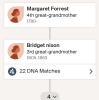
I recently received my DNA results and, on browsing through the ThruLines, noticed that both people in each couple have the same number of DNA matches - except for one couple. One of my 4th GGM has 22 DNA matches against her name but her husband has zero. My immediate assumption - especially as I cannot locate a birth for their daughter - is that I've got the wrong person down as the husband/father, although I've since checked the records I have (married 1794 in Dalkeith) and can't work out what might be wrong. I feel there might be an important clue in this anomaly but can't begin to work it out. Does anyone have any advice or hints, please?
 
In there is a discrepancy in the spelling of surnames Ancestry doesn't connect. I have big discrepancies where the spouse is Mitchel/Mitchell or McKenzie/MacKenzie. If I amend the surname spelling in my tree to the other spelling then after a period the thrulines situation sometimes changes, though not always.
 
I have a discrepancy in the spelling of mine that makes no difference, My 4th great-grandmother was Elizabeth Joice, her son (illegitimate) was James Joyce. The Joyce name continued down to my Dad.
 
Thanks for those suggestions. There doesn't seem to be any spelling discrepancy, so that removes one possibility! I will try contacting the shared matches to see if they have any more information.
 

Attachments

  • upload_2024-6-3_19-37-24.png
    upload_2024-6-3_19-37-24.png
    48.1 KB · Views: 6
The spelling discrepancy isn't necessarily in your own tree or between individuals in different generations, it's in the trees of others. Ancestry can struggle to link individuals across trees if you have a different spelling or name on your tree than someone else has on theirs - even if they're the same person. I think they're getting better at it, but it doesn't mean that it's perfect.
 
I will try contacting the shared matches to see if they have any more information.
Is it really worth it? I don't look at these numbers, since even if they are correct they will only confirm what I already have in my tree.

I certainly wouldn't contact my matches just to diagnose a glitch in Ancestry's system. For a start, they might get the impression that they are being accused (rightly or wrongly) of entering incorrect information.

But it may be I'm missing something important - if so please explain in case I need to update the Masterclass!
 
I have a similar experience with my 3 x Great Grandparents . The male shows I have 8 DNA matches but his wife shows I have 0 DNA matches. All other ancestor couples on the other hand show equal number of DNA match with the male and female in the couple.
Why is this and how can it be best explained?
 
I have a similar experience with my 3 x Great Grandparents . The male shows I have 8 DNA matches but his wife shows I have 0 DNA matches. All other ancestor couples on the other hand show equal number of DNA match with the male and female in the couple.
Why is this and how can it be best explained?
What happens when you look at Common Ancestors - does it show that these people are only half-cousins of yours? If so, that's the root cause of the problem, ie Ancestry does not think that your ancestor and their ancestor are the same person.

Also as I asked above, what's the point of looking at ThruLines when you already have Common Ancestor matches with the same cousins?
 
Struggling to understand the scientific side of this as I would like to know the facts and wish to know if the woman I have as my 3 x Great Grandmother is biologically linked to me. My common ancestors show as half cousins etc from her husband, my Great Great Grandfather so I concede that the woman I thought was my 3 x Great Grandmother may not be the mother of the child that I am descended from, but my closer cousins (2nd cousin 1x removed, and 3rd cousin 1x removed) are not half cousins so presume our ancestors are the same person? Despite this, my so called 3 x Great Grandmother is showing as 0 DNA match. How can she biologically be my relation when she shows as a zero match? I can only find one wife/marriage for the two people concerned and they had two children, that I know of. The husband and children and Grandchildren all show as DNA matches but not her. I have done the DNA course and am an experienced genealogist of over 30 years but admit the scientific side, I am struggling with.
 
Struggling to understand the scientific side of this
There is no scientific side to ThruLines - it's just a theory based on family trees. As is Common Ancestors, which is what you should be using.

Note: You didn't answer any of the questions in my previous post, so I can only advise you in general terms.

Follow the advice in the Masterclass and don't allow yourself to get sidetracked: start by validating your own tree as far as you can using DNA matches, then focus on the 'brick walls' that are within range of DNA. Until you get some experience of working with DNA the chances are that any apparent anomalies are artefacts, so don't waste time worrying about them.
 
It is worth noting that individuals shown as "half" cousins may not actually be half cousins. Ancestry can identify them as half cousins if they have a different way of spelling your shared ancestor's name.
 
I don’t open up ThruLines from the summary page, but when looking at a Common Ancestor match details, then sometimes I go from there to ThruLines to remind myself who else shares the same ancestors.

But the thing to remember, as has been said before, is that Common Ancestors (like ThruLines) are hints based on a comparison with other people’s trees. If a Common Ancestor match is with one half of a couple only, it doesn’t mean your tree has the incorrect other half. There are essentially 4 main possibilities - 1) your tree is incorrect, 2) the trees of your Common Ancestor matches are incorrect, 3) both trees are correct but your CA matches descend from a different marriage and are genuinely half cousins of some degree, or 4) both trees are correct and your CA matches are actually whole relatives but have entered one half of the couple differently such that Ancestry does not recognise them as being the same person as the one in your tree.

Once the relevant trees have been carefully checked, it should be possible to tell which scenario applies.
 
On the subject of Common Ancestor and ThruLines anomalies, I have an odd one which has recently appeared. I have two brothers among my matches who I know to be my half first cousins once removed - my grandfather is their great grandfather.

Brother one has a public tree with just two people (showing as private) in it, apparently himself and his father (my half cousin). Brother two does not have a tree but is now showing as a Common Ancestor match, the common ancestor showing correctly as my grandfather. However, there is no ‘Evaluate’ link, so no connected trees showing. It is showing the ThruLines link, but if I follow that it shows just the three descendants of my grandfather - me, my sister and our mother.

Very odd!
 
Last edited:
On the subject of Common Ancestor and ThruLines anomalies, I have an odd one which has recently appeared. I have two brothers among my matches who I know to be my half first cousins once removed - my grandfather is their great grandfather.

Brother one has a public tree with just two people (showing as private) in it, apparently himself and his father (my half cousin). Brother two does not have a tree but is now showing as a Common Ancestor match, the common ancestor showing correctly as my grandfather. However, there is no ‘Evaluate’ link, so no connected trees showing. It is showing the ThruLines link, but if I follow that it shows just the three descendants of my grandfather - me, my sister and our mother.
Ancestry don't show information from private trees, but they will show public information inferred from private trees. The way it works is clearer when the common ancestor(s) are further back.
 
Ancestry don't show information from private trees, but they will show public information inferred from private trees. The way it works is clearer when the common ancestor(s) are further back.
No, he didn’t have a private tree either, at least not a searchable one, and they don’t use private and unsearchable trees for ThruLines and Common Ancestors. His account is showing no trees of any sort.
 
Last edited:
No, he didn’t have a private tree either, at least not a searchable one, and they don’t use private and unsearchable trees for ThruLines and Common Ancestors. His account is showing no trees of any sort.
I'd always thought that only those matches with linked trees (public or private) would show up as Common Ancestor matches. That has been my experience up to now, but your experience shows otherwise. And on checking the 300 or so Common Ancestor matches for myself and my husband, all have linked trees with just one exception. That person (a 4th cousin whom I've been in contact with and know how we are related) has 3 small public trees, none of which seem to feature this cousin's ancestors at all. So I'm not sure how Ancestry have worked out (correctly) our common ancestors. Presumably someone else must have this person in their on-line tree.
 
No, he didn’t have a private tree either, at least not a searchable one, and they don’t use private and unsearchable trees for ThruLines and Common Ancestors. His account is showing no trees of any sort.
You said that his brother had a minimal private tree: full siblings have the same ancestors. Ancestry most certainly DO use private trees in order to work out who has Common Ancestors - there have been plenty of examples amongst the tests that I manage. As I indicated in my previous post, this is more obvious when the Common Ancestor(s) are further back, because then you might see that some of your cousins' ancestors are named and some aren't.

There's also the possibility that some DNA matches appear as hidden living individuals in the trees of relatives, though it's not something I've ever looked into. Just so long as Ancestry come up with the goods it doesn't much matter to me how they do it.
 
You said that his brother had a minimal private tree
Actually I said it was a public tree, with just two people in it - himself and his father, but not his brother. However, the tree is not linked to his DNA results (which I didn’t mention before). So the brother with the unlinked tree isn’t showing as a Common Ancestor match, while the brother without any tree at all is.

But the lack of ‘evaluate’ buttons means I can’t tell where the information comes from. Normally I would expect to see his line of descent from our common ancestor, which in this case would be my half uncle, then my half cousin (private as he’s living), then him as the match at the bottom.

So in that sense Ancestry is not coming up with the goods. And while I happen to know what our relationship is in this case, if I didn’t, I’d still be in the dark as to whether we were in the same generation or what.
 
Last edited:
all have linked trees with just one exception
With the exception what do you see when you view the details of the Common Ancestor match? Are you seeing the usual descent of the match from your common ancestor, with the ‘evaluate’ button for each generation? Or are the match’s descent details missing as I’m finding?
 
Back
Top