• Only registered members can see all the forums - if you've received an invitation to join (it'll be on your My Summary page) please register NOW!

  • If you're looking for the LostCousins site please click the logo in the top left corner - these forums are for existing LostCousins members only.
  • This is the LostCousins Forum. If you were looking for the LostCousins website simply click the logo at the top left.
  • It's easier than ever before to check your entries from the 1881 Census - more details here

SideView

Beg to differ Peter. Ancestry use 'phasing' to separate and identify what is paternal vs maternal DNA. The process is probably similar to how a "Lazarus" kit is built on GEDmatch for a parent who has passed. The more relatives and the closer the relatives to the 'missing' parent the better the chances of identifying DNA segments belonging to that parent/person (on GEDmatch at least). Maybe not 'essential' as Ancestry will still do it's best, but more close relatives for Ancestry to use the better the result and the fewer the unassigned matches.
A segment is either on one side of your tree or the other (both only if it is homozygous). There is a theoretical advantage with close matches, as Ancestry could reasonably assume that all of those segments were inherited via the same parent, but we know they don't do that - if they did there wouldn't be so many 1st cousins shown as 'Both sides' or 'Unassigned'.
 
Can someone please explain why DNA origins don't match common communities please?
This is what Ancestry say about communities:

"These are people who share a significant number of matches with each other. Members of a community likely descend from a group of people who traveled to the same place around the same time or from the same place around the same time."

DNA origins is looking at where people are from, not where they went.
 
  • Like
Reactions: SLJ
Only thing I'm a little confused. Can someone please explain why DNA origins don't match common communities please?

My understanding, which could be wrong, is that DNA origins are where it looks as though your parents' ancestors came from, whereas common communities are where a lot of your matches on that side appear to live or have lived more recently?

... that's mostly right, but the information in Peter's post clarifies the definition of communities further.
 
Last edited:
  • Like
Reactions: SLJ
This is what Ancestry say about communities:

"These are people who share a significant number of matches with each other. Members of a community likely descend from a group of people who traveled to the same place around the same time or from the same place around the same time."

DNA origins is looking at where people are from, not where they went.

Thank you that makes sense, so origins I understand to be where from and now I understand that common communities are where people are now, phew, was beginning to think it was wrong.
 
Something I have noticed about Parent 1 and 2. Don't assume as I did that Parent 1 is the same side for you as it is for someone else.
ie Parent 1 on my tree is maternal side whereas on my partners tree Parent 1 is paternal. Hope this helps others.
 
Thank you that makes sense, so origins I understand to be where from and now I understand that common communities are where people are now,

Ancestry also say:

"Our communities white paper explains how we use the public family trees of members of our DNA database in conjunction with identical-by-descent networks to identify communities of origin and their patterns of migration."

So they're not just looking at DNA when it comes to communities. I suspect that this is most relevant for users in the US and Canada because of the way that people from the same areas tended to end up in the same locations, and in some cases didn't inter-marry with other communities.
 
The match I copied that text from is actually my sister's closest (not counting me) so I was guessing SideView had assigned it as 'Both sides', but I haven't checked this. I don't know how quickly it updates if I remove the relationship I'd added.
If you go to the relevant person and edit relationship, select reset to default it will show Ancestry's allocation instantly. After that you can redefine it if you wish.

Regarding my previous item about an incorrect allocation to my mother's side, the Ancestry member (3C 24cM - descended from my paternal grandmother's younger brother) has six shared matches - 4 2C1R, 1 each 2C2R, 3C. The first three (179cM, 168cM, 148cM) Ancestry have as Unassigned, the others (145cM, 124cM, 41cM) are Paternal. The first 5 are all descended from my paternal grandmother's older sister and the 6th from her mother's youngest brother.

From various "snippets" in previous messages, it looks to be a case of more is less! From my research, my grandmother's ancestors are from Southwick, North Bradley, Trowbridge and Rode - with very few Furriners.
 
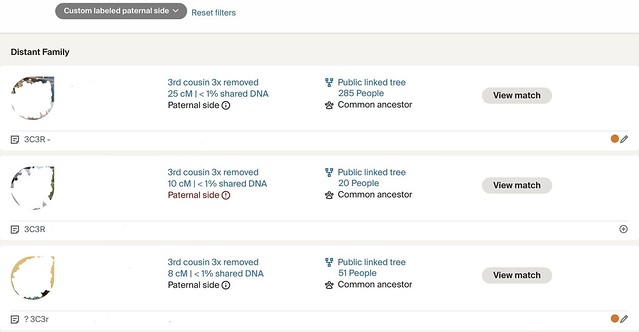
In regards to the "coloured" information dots - I have only noticed black and red > but I grabbed a few screenshots to assist.

In regards to the black information dots (very easy to find when you use the "custom labeled" filter:
52416998970_e45f6b2510_z.jpg


As for the red ones:
52416837644_d603654a20_z.jpg


And when you click - It's worth noting that the Common Ancestor tag for this result suggests a paternal match, which is curious:
52416555941_23f5b3d9f1_z.jpg


Hope that helps?
 
And when you click - It's worth noting that the Common Ancestor tag for this result suggests a paternal match, which is curious:
This looks like another example of a discrepancy between ThruLines and SideView, as I mentioned previously (post #84). I have 4 matches (3 of them closely related to each other) of similar low cM where ThruLines points to a maternal link but SideView labels them as Parent 1 (i.e. Paternal side in my case). I hadn't labelled any of these myself, so no red 'i'.
 
This looks like another example of a discrepancy between ThruLines and SideView, as I mentioned previously (post #84). I have 4 matches (3 of them closely related to each other) of similar low cM where ThruLines points to a maternal link but SideView labels them as Parent 1 (i.e. Paternal side in my case). I hadn't labelled any of these myself, so no red 'i'.
I wouldn't call it a discrepancy - they are providing hints from different sources. ThruLines (and Common Ancestors) are hints based on trees, SideView provides hints based on DNA. If you are related to a cousin on both sides of your family it's quite possible that only one route is supported by trees and only one by DNA.

The number of shared segments provides a clue as to how reliable the SideView assessment is - the more segments there are, the less likely it is that they have all been assigned to the wrong side of your tree.
 
I wouldn't call it a discrepancy - they are providing hints from different sources.
Perhaps discrepancy was the wrong word. I was intending to convey a difference between hints from different sources, not saying which is right. And I agree the fewer the segments the more likely the assignment to the wrong side of the tree (e.g. those of 8-10 cM and only 1 segment). However, the 'more the better' is not true of hints based on trees, as many trees have the same error copied from other trees.
 
However, the 'more the better' is not true of hints based on trees, as many trees have the same error copied from other trees.
Indeed, as I have just written in another thread. And it doesn't always apply in the case of SideView, as we have previously noted that close matches are more likely to be shown as 'Both sides'.
 
However I should say that so far I haven't notice an examples where the Common Ancestor is at odds with SideView.

I have one, a person who I know is on my maternal side because a) when I was researching her tree I corresponded extensively with both his mother and grandmother and b) when he matched me on Ancestry I messaged him and confirmed that he was in fact the person I thought he was. Ancestry gives me the correct common ancestors (my mother's grandparents) but it says my match is paternal.
 
Here's a thought - half of which is obvious - about both-sides matches.

I have only one match on both sides: my niece. Historically speaking, I labelled that match as "niece" and as "both sides" - both choices were offered together. But now it only shows up with the "both sides" filter, not with the "custom labelled both sides" one. So Ancestry is saying I didn't label it.

There are two steps in Ancestry's processing to get these SideView labels. First they go through all your matches doing a comparison with your DNA and comparing those comparisons to see which fit with each other. That sorts you matches into a number of heaps where your DNA that matches them looks to be inherited together. The two biggest heaps get called parent 1 and parent 2, and any small heaps mostly unassigned. But some matches show some fit with both main heaps, and may get labelled "both sides".

There are thresholds involved in this sorting, so there is an act of choice about is it one side or the other or both. But that's internal to Ancestry, and we can't interact with it. The choice we are being offered with the (i) icon can't affect that, it's about the second processing step. That resolves the arbitrary parent 1 and 2 as mother and father, and of course applies to all the matches in both those big heaps. There cannot, logically, be such a choice for "both sides". So presumably we don't get offered it, and won't see that (i) icon.

So, has anyone ever seen a both sides match with the (i) icon or with the "custom labelled both sides" filter?
 
Mum has one match that Common Ancestor traces back to a mutual COOPER, Mums maiden name, in 1753, so it is Paternal. Side View states it is Maternal!
Interestingly the Surname of the match is a COOPER, but from a different part of England, but has a COOPER ancestor ,who marries a Miss TAVENOR from Staffordshire. My Mums maternal family lived in Staffordshire at the time that Miss TAVENOR was born. At the moment I cannot see a link but it is interesting.....
 
I have one, a person who I know is on my maternal side because a) when I was researching her tree I corresponded extensively with both his mother and grandmother and b) when he matched me on Ancestry I messaged him and confirmed that he was in fact the person I thought he was. Ancestry gives me the correct common ancestors (my mother's grandparents) but it says my match is paternal.
He might be related to you on your father's side as well - but unless finding the connection is going to help you knock down a 'brick wall', there's little point investigating.

You haven't mentioned how many segments he shares with you - if it is only 1 then it's very likely that this one of the 5% of segments that SideView gets wrong. If it's more than 1 then it's more intriguing.
 
Last edited by a moderator:
I have only one match on both sides: my niece. Historically speaking, I labelled that match as "niece" and as "both sides" - both choices were offered together. But now it only shows up with the "both sides" filter, not with the "custom labelled both sides" one. So Ancestry is saying I didn't label it.
That's not how I would interpret it - surely Ancestry are telling you that their assessment agrees with yours?
 
He might be related to you on your father's side as well - but unless finding the connection is going to help you knock down a 'brick wall', there's little point investigating.

You haven't mentioned how many segments he shares with you - if it is only 1 then it's very likely that this one of the 5% of segments that SideView gets wrong. If it's more than 1 then it's more intriguing.

Just one segment, 11cM
 
Back
Top