
• Only registered members can see all the forums - if you've received an invitation to join (it'll be on your My Summary page) please register NOW!

  • If you're looking for the LostCousins site please click the logo in the top left corner - these forums are for existing LostCousins members only.
  • This is the LostCousins Forum. If you were looking for the LostCousins website simply click the logo at the top left.
  • It's easier than ever before to check your entries from the 1881 Census - more details here

Married twice (not)

John Dancy

LostCousins Superstar
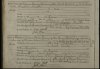
Looking for ancient relative, Thomas Hewins and Sarah Sansom, I found their marriage quite easily on FMP Entered the information on the tree, then looked at the image again. The next marriage was them as well, five months later. Only it wasn't. Whilst the second marriage was obviously theirs, the first marriage had been signed by a different couple, husband George Hall, wife Susanna Woollet. As on the image.
Have not seen this one before. If the record has incorrect names are the couple that signed it legally married ?
 

Attachments

  • Thomas hewins Double wedding.JPG
    Thomas hewins Double wedding.JPG
    98.1 KB · Views: 23
I see the second record has the dates of the banns squeezed into it. Have you any idea why that was done? That was not usually needed, certainly not on that form as it has no space for it. My first thought is that when they all turned up for the marriage the minister realised that the banns had not been called, so it was delayed. The date of that first one might not have been the same as the Hall/Woollet one. Obviously that still leaves the question of why Chambers left the names as they were!
 
Between 1754 and 1837 marriage registers were often printed with space for the banns at the top of each entry, while others had separate sections of the register for banns and marriages.

Where there is space for banns at the top of each entry like here, the banns and the marriage in each entry did not always correspond, so you might, for example, have the banns for John Smith and Mary Brown with the marriage in the same entry for Joseph Bloggs and Jane White.

However, here it looks like there may perhaps have been some sort of clerical error as there are no dates with the first banns entry, and no names for the bride and groom in the marriage part of that entry.
 
Between 1754 and 1837 marriage registers were often printed with space for the banns at the top of each entry, while others had separate sections of the register for banns and marriages.

Where there is space for banns at the top of each entry like here, the banns and the marriage in each entry did not always correspond, so you might, for example, have the banns for John Smith and Mary Brown with the marriage in the same entry for Joseph Bloggs and Jane White.

However, here it looks like there may perhaps have been some sort of clerical error as there are no dates with the first banns entry, and no names for the bride and groom in the marriage part of that entry.
Quite so - I had zoomed in slightly and removed the word "Banns" from the heading! I still think my guess does fit the upper form being "booked" for one couple who married later, but other things could cause that.

In this register, if you look at just a few pages around this entry, there are lots of blanks, banns with no marriage, and entries out of sequence, and others with the names before the signatures missing. So I don't see why the minister would feel he had to use that space at all costs. Maybe the explanation is much simpler - such as filling in the register was done in a very dark corner and they could barely see what they were doing!
 
If you look further up the same page, there was a marriage by licence, where the names of the bride and groom were in the banns section of the entry rather than just below in their proper places. That and other incidences reinforces my feeling that these were likely clerical errors. It was not unknown back then for couples to sign the register before the rest of the entry was completed, but clerical errors would not invalidate a marriage. There are clerical errors in the register at the marriages of at least 3 of my ancestors (pre-1837) but fortunately they could all sign their names so I knew I had the right marriage.

EDIT: I meant to say also that if the couple married in a different parish, and the clerk preferred not take a ‘mix and match’ approach, then you will find banns details entered with no marriage lower in that section.
 
Last edited:
I thought it was interesting that the groom in the first marriage was a witness to the second.
 
I noticed that but thought it unlikely to be of much relevance.
As he is literate and signed the register at both ceremonies you would think he might have pointed out the apparent error. It makes me wonder whether the banns information was added later, either from a notebook or another register.
 
As he is literate and signed the register at both ceremonies you would think he might have pointed out the apparent error
I thought that with the register errors when my three ancestors married (as mentioned in #5), who were likewise clearly literate. Maybe they did point it out and were told it would be sorted out later and then it wasn't. It would be great if we could know what really happened rather than having to just speculate!
 
I thought that with the register errors when my three ancestors married (as mentioned in #5), who were likewise clearly literate. Maybe they did point it out and were told it would be sorted out later and then it wasn't. It would be great if we could know what really happened rather than having to just speculate!
Or perhaps, as may have happened in this case, the incorrect information was added after they signed the register?
 
Back
Top