• Only registered members can see all the forums - if you've received an invitation to join (it'll be on your My Summary page) please register NOW!

  • If you're looking for the LostCousins site please click the logo in the top left corner - these forums are for existing LostCousins members only.
  • This is the LostCousins Forum. If you were looking for the LostCousins website simply click the logo at the top left.
  • It's easier than ever before to check your entries from the 1881 Census - more details here

Birth certificate question (England)

whitebullwifezig

LostCousins Member
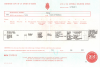
I'm looking at a birth certificate:

"When born: 29 Dec 1943"
"When registered: Second august 1950 on the authority of the Registrar General"
and at the far end is a stamp-like remark, "Previously registered on 11th February 1944 as entry No 303 in Chiswick sub district W E S".

When I ordered the birth certificate, I used the 1950 GRO reference, as I assumed she had been registered late due to them forgetting to register her at the time. Her 1944 reg is there but with a note saying she was added late, and Ealing is italicised. I also noted that Ealing didn't exist in 1943 as a civil reg district, so she couldn't have been registered in Ealing, so it didn't occur to me to try to order this from the GRO. I also don't think you can register someone twice.

Has anyone encountered something like this before? what's your conclusion - they were saying she was registered but they've lost it so are re-registering?

and my second question, I really wanted to know her dad's profession and the timing of it this job title is very important. Would you say this is a source for her dad's profession in 1950, or 1943?
 
Presumably when you say 'Ealing is italicised' you're referring to the transcription of the index entry at FreeBMD? For the benefit of other members following this thread, here's the Help information from FreeBMD:

Why are some districts in italics?
I've noticed that in the results some of the districts are in Italics. Why is this?
This means that there is something wrong or unusual about the district name, volume or page, specifically one of the following:

  • The district name found in the index differs from the standard district name and therefore there is a possibility that the district in the index is incorrect
  • The volume number is not the one expected for the district in the year and quarter of the entry
  • The page number is not within the expected range for the district and volume number in the year and quarter of the entry
Click on the district name for more information.
 
There are genuine "late" registrations but they are fairly rare, especially by this period. Births can certainly be registered more than once - twice is quite common, and three times also happens under some circumstances, but sadly the help system on FreeBMD marks all such entries as "late" which is very misleading.

It will almost certainly be a re-registration. These are most commonly done when the parents ( not a step parent) of a child marry after the child was born, but can also be done to add an unmarried father if he wasn't named on the original entry, or for any other reason the registrar general deems necessary.

By looking at how each entry is indexed, and checking when/if the parents married it is usually possible to work out the most likely sequence of events, but to be certain you need to order a certificate from each entry.

Without seeing the details I can't help further with which reason it probably was.
 
By looking at how each entry is indexed, and checking when/if the parents married it is usually possible to work out the most likely sequence of events, but to be certain you need to order a certificate from each entry.
Often looking up the birth in both the quarterly indexes and the new birth index on the GRO site provides clues to the sequence of events however neither year is currently in the new index. (This may change when the current project to scan registers is complete, although the GRO have so far given no details as to what will be included.)
 
to be certain you need to order a certificate from each entry
If you do decide to order both you'll need to be explicit about wanting a copy of the original 1944 entry, otherwise the GRO will give you the 1950 version by default. I'm not certain whether the local register office would follow the same procedure, but best to make sure.

I would recommend ordering the 1950 version first. If it turns out that the birth was not re-registered, and instead the original entry was updated, you won't need anything else. (You may be able to distinguish between these possibilities by carefully reviewing the entries in the images of the quarterly indexes.)
 
Peter raises an important point - when ordering a certificate from a birth that has been re-registered later GRO do often try and be "helpful" and automatically send the later entry instead. This has been raised as a problem with them on more than one occasion and they have promised to follow the proper procedure which is to send the certificate that was ordered and enclose a note to draw attention to the later entry, but this doesn't always happen. If they do send the later one, a phone call will get the correct one issued.

This cannot be an update or correction to an earlier entry - that would not generate a new index entry in a later year.
 
If they do send the later one, a phone call will get the correct one issued.
In that case, maybe best to order using 1944 references, then you might get both for the price of one?
This cannot be an update or correction to an earlier entry - that would not generate a new index entry in a later year.
Thanks for the clarification - that's very useful to know.
 
Sorry fellas - here's some additional information.

The parents weren’t married (to each other). The mum was separated from her husband but had taken the surname of the baby’s father. (That’s why both surnames appear in her probate calendar entry.) I’ve attached a screenshot of the FreeBMD search result – the birth in question appears as both the 2nd and 4th entries.

Before ordering, I checked the original images used to transcribe the FreeBMD index. I concluded she’d been missed entirely in 1943 – the screenshot attached shows why I didn’t try to order that version. There’s no GRO reference, and Ealing didn’t even exist as a registration district at the time.

I’ve attached the certificate I received in the post and I’m stumped. It shows the birth was originally registered in the now-abolished Chiswick district in Feb 1944 ("entry 303, 11th February 1944"), but that doesn’t seem to appear in FreeBMD at all. I’m not sure if I should try ordering it using just that information – and whether they’ll charge me full whack without the reference. And why was this re-registered?

Someone needs to write the birth index version of the book A comedy of errors, or, The marriage records of England and Wales - I'd buy it.

Would you say this is a source for her dad's profession as of 2nd August 1950, or 11th Feb 1944?
 

Attachments

  • Wilson_Ann_Birth_1943.png
    Wilson_Ann_Birth_1943.png
    1 MB · Views: 12
  • Screenshot 2025-08-05 at 21.34.15.png
    Screenshot 2025-08-05 at 21.34.15.png
    123.5 KB · Views: 12
Remember the added information at the right side of the certificate, which says that the first registration was entered in Q1 1944. The sub-district was Chiswick, which was in Brentford district (volume 3a).

Now that entry is likely to use another surname - just about the best way to make it impossible to find. You can look up that entry in FMP's birth index, using just 1944, Brentford, Ann, and MMS Stanley. There is only one result:
Ann Sherrad 1 1944 Brentford Middlesex

And that is, I find, her first married name (though also spelled Sherred and I suspect other ways too).

In the attached image (of page 169 of the index for Q1 1944) we see
upload_2025-8-5_23-10-51.png
You'll need to get that entry (certificate) too see if she registered with her husband's name as father, or something else irregular enough to warrant a new entry.
 
The 1950 entry is a re-registration done to add an unmarried father who wasn't named on the original entry. Although the mother is using the name Wilson at this time the parents are not married (or claiming to be)....you can tell that because they both signed the entry as "joint informants".

The occupation for the father is probably what he was doing in 1950, but doesn't have to be.
 
I'm still puzzling over this business of what needs a re-registration and what can be done with a correction. The current rules (in the GRO web pages) say adding or removing a father only needs a correction. The parents marrying needs a re-registration. In Ann Wilson's case the mother's surname changes to match the "new" father's which is what marriage would usually do. So I guess that could be what needs a re-registration.

However, in this case the sub-district and district of the original registration have been abolished. What would that imply for the locally-held registers? If it was just the sub-district I can imagine the books would go the district register office. But here, perhaps they went to the GRO and so could not be corrected locally. But would that matter? Why not do it at the GRO?

One other thing to note is that a change of registered father would in most cases change the indexed surname, i.e. what is normally understood as the child's surname. Thus the index change (e.g. the hand-written entry made in 1950) has to go on the right page of the old index for the new surname, so as to intercept a search for "Ann Wilson" and send it to the replacement entry. That's why it refers to Ealing as the district and S50 as the index issue; it's the new entry that has to be found and copied as a certificate.

As ChalfontR says, a correction does not create a new entry so the index reference (volume and page) remain the same. But I presume there still has to be a new line in the index (handwritten in 1950) on the right page to intercept a search using the new surname. And one final pedantic point - if the registration was in the quarter following the birth (as this one was), which quarter's index should the new entry be in? Or does it not really matter?
 
However, in this case the sub-district and district of the original registration have been abolished. What would that imply for the locally-held registers? If it was just the sub-district I can imagine the books would go the district register office. But here, perhaps they went to the GRO and so could not be corrected locally.
Registration districts don't just disappear, they get merged into other districts. So the registers are handed over.
 
you can tell that because they both signed the entry as "joint informants".

Thank you - this is a great detail and exactly the sort of intel I was after.

thank you everyone for the discussion so far. I have ordered the " Sherrad" birth certificate and will report back if anyone is interested.

Mr Sherred was in a PoW camp by the time of the birth but given he possibly could have been on leave from ww2 it was theoretically possible (on paper) for him to be the dad but I hadn't considered using his name on FreeBMD because I know from DNA that she is a full sibling to another child who can't be Mr Sherred's. It just goes to show how what we know can hinder the search process. .
 
The current rules (in the GRO web pages) say adding or removing a father only needs a correction.

In some circumstances yes ( although not usually if no father was recorded originally) ....but it would be a "correction of fact of substance" which requires significant evidence and a file to be sent to the registrar general for permission. The re-registration process to add an unmarried father is a statutory process authorised at the local level and something done every day.

In Ann Wilson's case the mother's surname changes to match the "new" father's which is what marriage would usually do. So I guess that could be what needs a re-registration.?

No - her name is irrelevant to the need for re-registration. All registrations should usually show the name a person "uses or is known by" at the time of the event, so if she is using the name Wilson ( which she is free to do, married or not) then that is what should be shown.
 
Last edited:
As ChalfontR says, a correction does not create a new entry so the index reference (volume and page) remain the same. But I presume there still has to be a new line in the index (handwritten in 1950) on the right page to intercept a search using the new surname. And one final pedantic point - if the registration was in the quarter following the birth (as this one was), which quarter's index should the new entry be in? Or does it not really matter?

For a re-registration like this, the amended index entry will be added to the quarter in which the birth occurred - which it is in this case - there is a handwritten addition in the Oct-Dec index for 1943
upload_2025-8-7_9-49-27.png
 
Examples like this one just show that it is impossible to confirm research when working from indexes alone without making some element of assumption or guesswork.

For instance - from the index there is no way of knowing whether the 1943 entry under Sherred has a father named on the entry or not....it certainly doesn't have Mr Wilson named, but might have the husband named, or might be blank.
 
I'm a bit confused as to the rules on re-registering your child's birth - when was this done?

Re-registering of births is done for two main reasons:

After the later marriage of the parents ( after the Legitimacy Act 1926)
To add an unmarried father when he wasn't named on the original entry

They have always been possible, but become very common after 1926 and through the C20th. With the current fashion for many marriages to take place after children come along the re-registering of births is something that a registrar does almost every day.

Some birth can now get registered three time - first with just the mother shown, then again to add the unmarried father and again once the parents marry.

In can also be done for any reason the registrar general feels necessary ( usually after a fraudulent entry or an error that can't be corrected, like a birth being registered in the wrong district).
 
Last edited:
https://ibb.co/CKzD4b2g
The link above is a copy of both certificates, to conclude this tale!

the top one was the first Id ordered and prompted this initial discussion. I then ordered the bottom one with your help. I still don't know why this was re-registered - was it legally necessary? The father on the 2nd certificate is dna-confirmed as correct.
 
Whenever looking at a re-registration it is so important to see both entries. The chain of events seem to be:

The birth in Dec 1943 is registered ( in Jan 44) by her mother. The inclusion of a maiden name (shown as "formerly") indicates she is, or has been, a married woman. There is no father named, so she didn't try and claim that her husband was the father , as she could have, although it would have been perjury if she knew it to be false. Unless the actual unmarried father was present his details couldn't be entered so the father's name is left blank.

In 1950 the birth was re-registered, with both parents present. The mother is using the father's surname but there is actually no way to be certain if the parents were married at that time just from the way the entry is worded. If the mother was already married in 1943 then even if this couple had married later the provisions of the Legitimacy Act wouldn't apply because at the time of the birth one of the parents (maybe both ?) were not free to marry. So the birth was re-registered as still to unmarried parents and both signed as informants.

There was no legal requirement for them to re-register the birth, it was something they chose to do presumably to ensure the father's name was recorded.
 
Last edited:
Back
Top