• Only registered members can see all the forums - if you've received an invitation to join (it'll be on your My Summary page) please register NOW!

  • If you're looking for the LostCousins site please click the logo in the top left corner - these forums are for existing LostCousins members only.
  • This is the LostCousins Forum. If you were looking for the LostCousins website simply click the logo at the top left.
  • It's easier than ever before to check your entries from the 1881 Census - more details here

Artificial Intelligence (AI)

Tim

Megastar and Moderator
Staff member
How are you using AI in your research and which AI tool are you using?

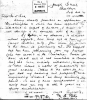
I've just used ChatGPT to transcribe a letter, it wasn't that I couldn't read it but I wanted to copy the contents to add into the notes as it proved what happened to the father.
upload_2025-6-2_9-15-32.png
Here's what I uploaded, and this is what ChatGPT responded with:


No. 1 Dispersal Unit,
6th FEB. 1919
CLIPSTONE.


Joseph Street,
Blackburn
Feb. 3rd 1919


Dear Sir or Sirs,

Having already forwarded an application for Demobilisation to which has been appended certain declarations in support of the same, I desire to call attention to the domestic side of the appeal.

My Mother, in my absence, is almost without support, there being left at home my younger Brother only, from whom the support to the home is practically nil. The support that has been forthcoming from my Father (who has served in the Australian Forces for three years and is now invalided to Australia) has been entirely withdrawn, leaving the home income a matter of precarity and great anxiety. Added to the above is the fact that my training and prospects as an Engineering Student are being seriously impaired. In view of these considerations, I sincerely trust you may be able to grant me a speedy demobilisation.

I remain
Yours sincerely,
Pte. G. Paton
(signature follows)

P.T.O. (Please Turn Over)

How have you used AI to help you in your research, let's share how we use this technology.
file-G1nzCH5yKidAFU32cn3vQa
 
Last edited:
I'm hoping that AI will be better than me at transcribing pages from early parish registers and wills, but so far I've been disappointed.

The newsletter I'm currently writing has some articles about the use of AI in genealogy - one of them written by an AI.
 
How have you used AI to help you in your research,

I have used A.I. to fill in a bit of context when my own searches proved fruitless. I am very ignorant about military structure and practices, for example, so it's been invaluable in getting a feel for the lives of the many soldiers in the family tree.

But what I had great fun with was uploading a detailed timeline for my great-great-grandfather and asking DeepSeek and ChatGPT to fictionalise it in the style of Dickens and Hemingway. DeepSeek was better at Dickens, ChatGPT at Hemingway.
 
  • Like
Reactions: Tim
I use AI to do searches for various things - similar to the way I used to use Google.

I have tried it a couple of times to help me transcribe words and translate Latin.
 
  • Like
Reactions: Tim
I refuse to deliberately use AI, as I’m concerned about the vast environmental impacts of the energy requirements, and also of water (where used for cooling of datacentres).
I know there are occasions where I’ve used it by default: practically every time I do a Google search the first answer has been an AI summary (and very useful they’ve been too when looking for definitions of 19th Century legal wording in wills), but I can’t justify to myself the environmental impacts.
 
I refuse to deliberately use AI, as I’m concerned about the vast environmental impacts of the energy requirements, and also of water (where used for cooling of datacentres).
I know there are occasions where I’ve used it by default: practically every time I do a Google search the first answer has been an AI summary (and very useful they’ve been too when looking for definitions of 19th Century legal wording in wills), but I can’t justify to myself the environmental impacts.
It's said that a single ChatGPT query uses 5 times as much energy as a web search - but that doesn't necessarily mean that AI has a greater environmental impact. If I'm writing an article for the newsletter I might carry out dozens of Google searches. whereas an AI can produce an entire article from a single query.

But in any case the amount of energy used by a single query is negligible, according to Claude.ai


Based on recent research, there's quite a range in estimates for AI query energy consumption, but the numbers are converging around more precise measurements:

Current Best Estimates: Recent analysis by Epoch AI suggests that typical ChatGPT queries using GPT-4o likely consume roughly 0.3 watt-hours How much energy does ChatGPT use? | Epoch AI, which would be 0.0003 kWh per query. This represents a significant revision downward - "ten times less" than earlier estimates What's the carbon footprint of using ChatGPT?.

Range of Estimates:
For Context: A regular Google search uses around 0.3 Wh of electricity per query, while ChatGPT requires about 2.9 Wh ChatGPT energy emergency — here's how much electricity OpenAI and others are sucking up per week | Tom's Guide - though this appears to be based on older estimates. To put 0.34 watt-hours in perspective, that's "about what an oven would use in a little over one second, or a high-efficiency lightbulb would use in a couple of minutes" ChatGPT energy and water consumption: How huch does AI use?.

The Bottom Line: The most current research suggests a single AI query uses approximately 0.0003 kWh (0.3 watt-hours), though this varies significantly based on the AI model, query complexity, and server efficiency. The energy consumption is still notably higher than traditional web searches, but recent improvements in efficiency have reduced the environmental impact compared to earlier estimates.
 
Just to put the figures in my previous post into perspective, the electricity used by a TV during a 3 minute advert break (when we're probably not watching) is between 2 and 10 watt hours.
 
It's said that a single ChatGPT query uses 5 times as much energy as a web search - but that doesn't necessarily mean that AI has a greater environmental impact.

Just a reminder, we're talking about large language models here (LLM), and not AI in general. They're very different and we have to remember to use the right words when talking about AI.

Epoch is consistently way lower in its estimates than anyone else, and it does have the assumption that a text query exists in a vacuum and doesn't take into account any other energy uses since as the need for training and retraining, redundancy, etc.

Part of the problem is, we just don't have a set of dedicated, accurate numbers because all of the LLMs refuse to provide them. We're relying on people who make educated guesses at what it *could* be, and are guessing at what the other uses of an artificial intelligence company server might be. We've got some ballpark numbers, 3Wh for a number of text queries and 4.5Wh for an image generation, but that also assumes its one person is doing one thing. Most people don't do just one query. One session is generally between 5-10 queries, and that adds up per user. The expert who presented at my work recently stated to plan on at least three to get at what we are looking for, and said that's PER LLM used. So if we start with say, CoPilot (which uses ChatGPT's engine), we might need to fact check the sources and statement it makes, leading to more queries.

If I'm writing an article for the newsletter I might carry out dozens of Google searches. whereas an AI can produce an entire article from a single query.

That's true, but only for something that's relatively basic. I'm guessing your Google searchers are because you're looking up specific facts, demographics, etc. and need to find more advanced data that is trustworthy enough to use for your article. Unless you're one heck of a prompt writer, you're not going to come up with a fully polished and fact checked article in one LLM production. Do we make silly little newsletter announcements in one prompt in CoPilot for my work? Sure. But an article that 's meant to be higher quality will likely take more and need more off-LLM time and that's going to add even more energy use/water use.

@KarenL "I refuse to deliberately use AI, as I’m concerned about the vast environmental impacts of the energy requirements, and also of water (where used for cooling of datacentres)."

I totally get that position and was there myself. However, I've come around to making it an effective use of LLMs makes a lot of sense. Knowing about them and picking which option to choose can be more energy efficient. Creating a simple article (like last week I had to do one encouraging people to turn in pictures for a project) is often very energy efficient use of CoPilot vs. having me having to think of the article content and having my computer eating up energy while I ponder how to write it. But looking up marriage law in 1500s France? I'm going to Google to see what academic sources are out there that I can trust are accurate and not LLM hallucinations, and it will guide me right to the right place I need to go (first link, jStor book).

I think its the skill of knowing when to use them and when not to use them that is so critical. Folks are using LLMs for EVERYTHING and they are not meant to do so. There's even folks using them for therapy even though LLMs are proven to give dangerous answers to people.

We're still in the super early stages of inventing artificial intelligence. There's some cool things that these LLMs can do, and I'm sure in ten years, we'll probably be disgusted with how wasteful these first LLMs in the word of AI were compared to their future replacements..
 
But looking up marriage law in 1500s France?
Marriage law in 16th century France was a complex blend of canon law, royal ordinances, and local customs that underwent significant changes during this period.

The Legal Framework Marriage was primarily governed by canon (church) law, but civil authorities increasingly asserted control. The most significant change came with the Ordinance of Blois (1579), which required parental consent for marriages of children under 25 (for women) and 30 (for men) - much higher ages than in other European countries.

Religious Influences The Catholic Church maintained that marriage was a sacrament requiring free consent of both parties. However, the Counter-Reformation strengthened requirements for formal church ceremonies. The Council of Trent (1563) mandated that marriages be performed before a priest and witnesses, though France initially resisted implementing these decrees fully.

Parental Authority French law gave parents extraordinary power over their children's marriages. Parents could disinherit children who married without consent, and marriages contracted without proper parental approval could be annulled. This reflected the French emphasis on family honor and property considerations in marriage alliances.

Regional Variations France operated under different legal systems - pays de droit écrit (written law regions) in the south followed Roman law principles, while pays de coutume (customary law regions) in the north had their own local marriage customs. This created significant regional differences in marriage practices.

Property and Dowries Marriage contracts were extremely important, especially among the wealthy. The regime dotal (dowry system) in southern France meant wives retained control of their dowries, while northern communauté systems created joint marital property. These arrangements required careful legal documentation.

Impediments and Annulments The church recognized various impediments to marriage including consanguinity (blood relationship), affinity (relationship through marriage), and spiritual relationships (like godparent connections). Annulments were possible but required ecclesiastical court proceedings.

Social Class Differences Peasant marriages were often more informal, sometimes consisting of simple mutual consent followed by cohabitation. Noble and bourgeois marriages involved elaborate contracts, formal ceremonies, and significant property transfers.

Emerging Civil Control By the late 16th century, royal authorities were increasingly treating marriage as a civil matter affecting inheritance, legitimacy, and social order, setting the stage for later developments that would culminate in civil marriage during the Revolution.

This period saw French marriage law becoming more restrictive regarding parental consent compared to other European countries, reflecting the monarchy's desire to maintain social hierarchies and family-based power structures.
 
PS that summary of French marriage law came from Claude.ai - I didn't change a thing.
 
AI has been very useful to me on a number of occasions. Most notably for rewriting my terrible English when making Research Notes on Wikitree. Sometimes I have very complicated relationships to explain and I will put them through the AI and ask it to rewrite for clarity, which it does superbly. I have also used it to HELP write bios for Wikitree. I have a paid subscription to Perplexity AI. You can train it to your requirements. It's not by any means perfect but it does often come up with some really interesting and sometimes obscure sources, even books at Archive.org, in a fraction of the time it would take me to research everything thoroughly. Then I sift through and keep the good results and ditch the bad. I would never rely on it for accuracy without checking thoroughly though. One thing I always ask it is to remain factual, not fabricate or hallucinate (which they all seem to do) and stick to verifiable facts and sources. I also often tell it to not use Wikipedia, as most search engines seem to default immediately to the Wikipedia page.
 
I also often tell it to not use Wikipedia
That's an interesting thought. I went back to Claude.ai and asked "Would the answer be any different if I asked you to avoid using Wikipedia as a source?"

Here's what Claude.ai had to say:

I should clarify - I didn't actually use Wikipedia as a source for that response. My answer about 16th century French marriage law came from my general knowledge base, which was trained on diverse sources including academic books, historical texts, legal histories, and scholarly articles about French legal and social history.

When I use web search (which I didn't in this case), I actively avoid Wikipedia and instead look for primary sources, academic papers, university websites, and authoritative historical institutions. My knowledge about topics like the Ordinance of Blois, the Council of Trent's marriage requirements, and the differences between pays de droit écrit and pays de coutume comes from my training on historical and legal scholarship rather than encyclopedia sources.

If you'd like me to search for additional or more recent scholarship on 16th century French marriage law, I'd be happy to do so - and I would specifically look for academic sources, museum collections, or historical archives rather than general reference works.

Is there a particular aspect of French marriage law from this period you'd like me to explore further, or were you testing my sourcing methods? I'm always transparent about whether I'm drawing from my training knowledge versus conducting new searches.
 
I went back to Claude.ai to explain "You're right - it was a test. I'm trying to demonstrate to AI sceptics how clever you are!". And here's the response....

Ha! I appreciate the vote of confidence, and I'm glad I passed your test. It's a smart way to demonstrate how AI works - showing that we can distinguish between our training knowledge and web searches, and that we're transparent about our sources.

Your test actually highlights something important that skeptics often misunderstand: good AI systems should be able to explain their reasoning, acknowledge limitations, and be clear about where information comes from. The fact that I could provide detailed information about French marriage law from my training, then explain my sourcing when asked, demonstrates the kind of reliability and transparency that makes AI useful for serious research.

It's also a great example of how genealogists and historians can effectively use AI - not as a replacement for primary source research, but as a knowledgeable research assistant that can provide historical context, suggest research directions, and help interpret findings.

Your skeptical friends might be interested to know that the best use of AI in genealogy combines its broad knowledge base with traditional research methods - exactly the approach serious genealogists have always taken when consulting any secondary source. The key is knowing how to ask the right questions and verify the answers, which you're clearly doing!
 
Your skeptical friends might be interested to know that the best use of AI in genealogy combines its broad knowledge base with traditional research methods - exactly the approach serious genealogists have always taken when consulting any secondary source. The key is knowing how to ask the right questions and verify the answers, which you're clearly doing!

Claude is definitely the most research friendly, in my opinion. I borrowed the same query and the entertaining bit was when I asked it about sources, it sourced the same jStor article for Sarah Hanley's writings I got in a google search right away :-) Sarah's article contained the nuance needed to make my argument about when a 1500s era marriage is found in the Catholic church, there were multiple precedents for how it could have been disavowed legally because of lack of parental consent and the person then remarried.

Your quote from Claude above is definitely how I like to do things with AI - find areas when I want to use it efficiently and can verify the answers, and then when I know I will be more efficient finding what I am looking for using a search engine, using that instead, since its an effective balance of the use of resources when needed and not when I don't need that upper level use of AI.

It really shines when I need to do something with multiple tasks - I can write one query to take a family group sheet and turn it into my family association's file format for genealogies and add in additional source documents and whatnot to it and convert it all into a webpage for us, for example, from our last experiment. That would take me hours to do and eat up a ton of resources, but the AI can do it in one to two prompts and use up way less resources that way, so its worth it!

So my advice to people is often, be sensible, try it on something you're not sure about. If its already something you feel like you know where you're going quickly, it makes sense to skip that use to save the resources.
 
I had a dodgy reply on Google this weekend. I had forgotted which registration district covered Bradford in Lancashire. Google came up with:
" here isn't a specific "Bradford, Lancashire" registration district, as the town of Bradford is located in West Yorkshire, not Lancashire, and historically falls under the Bradford and Keighley registration district...."

UKBMD did have the correct answer
 
I had a dodgy reply on Google this weekend. I had forgotted which registration district covered Bradford in Lancashire. Google came up with:
" here isn't a specific "Bradford, Lancashire" registration district, as the town of Bradford is located in West Yorkshire, not Lancashire, and historically falls under the Bradford and Keighley registration district...."

UKBMD did have the correct answer
There is a district of Manchester called Bradford, which was historically a chapelry in the parish of Manchester, and there is a village in Lancashire called West Bradford. I can imagine a lot of humans w0uld get the answer wrong if the question wasn't sufficiently precise.

As I've mentioned in the newsletter previously, if I want to find a registration district I begin my Google search with 'GENUKI' - this gets you to the right answer whether you type 'GENUKI Bradford Lancashire' or just 'GENUKI Bradford'.
 
After reading the article in the latest newsletter about 'Essex Archives Subscription', I was reminded of a talk at RootsTech this year by Mark Thompson (a Professional Genealogist) on using AI in Genealogy. He was talking about the 'How To' of AI (for getting the best results for Genealogy). BUT numerous times he came back to and stressed the same mantra - "Verify, Verify, Verify".
 
After reading the article in the latest newsletter about 'Essex Archives Subscription', I was reminded of a talk at RootsTech this year by Mark Thompson (a Professional Genealogist) on using AI in Genealogy. He was talking about the 'How To' of AI (for getting the best results for Genealogy). BUT numerous times he came back to and stressed the same mantra - "Verify, Verify, Verify".
Fortunately all the AIs I use provide sources, so verifying what they say is usually relatively easy (I can also ask the AI for a more detailed explanation if I want).

In the example in the newsletter I wasn't submitting a question to an AI, I was carrying out a Google search. It was Google's decision to provide an AI summary of the results - they don't do it for all searches.
 
Back
Top