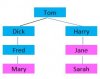
I have a match with a 3rd cousin who is estimated to be a 4th-6th cousin (Ancestry's estimation), because he is technically a half cousin (me descended from a son of my g-g-grandfather's first marriage; him through the second).
And on the same side of the family my father has a 2nd cousin (different cousin from above), who Ancestry estimates is actually a 5th - 8th cousin, which is another half cousin - from the same two sets of relationships: my g-g-grandfather's first and second marriages!
I have been in contact with both, and the relationships are crystal clear, so I figure the "half" portion is why Ancestry's estimations are so far out!
Someone who is a half cousin will, on average, share half as much DNA as someone who is a full cousin. By contrast when you go from the (say) 2nd cousin to 3rd the amount of shared DNA is divided by 4. (See this
chart on the ISOGG wiki.)
So no, the fact that they're half cousins wouldn't necessarily account for the differences in Ancestry's estimates, certainly not in the second case. But Ancestry's estimates are an approximation for the sake of convenience - what really matters is how much DNA is shared. These are the statistics that should be quoted in discussions on this forum, not Ancestry's very broad classification.
However when looking at the ISOGG table it's important to remember that the figures are averages: how much DNA we inherit from each of our maternal grandparents, and from each of our paternal grandparents is random, and the same applies further of the tree. The smaller the average amount of shared DNA, the greater the variance - if all 5th cousins shared precisely 3.32cM, as shown in the ISOGG table, matches between 5th cousins wouldn't show up at all. The matches that do show up are the ones where, due to chance, the amount of shared DNA is greater than average.
There is another factor that affects the statistics - some people will related in multiple ways, and in some populations the gene pool will be limited because of repeated inter-marriage. Someone might appear to a be a 4th cousin when in fact they're a 9th cousin 1000 times over!
In my family tree there's evidence that people often picked mates from other parishes, whether because they were aware of the dangers of interbreeding, or simply because it gave them a much wider choice. Has anyone else seen a similar pattern in their tree?