Exactly - that's why we can't see the explanatory information. If I'd known this was going to happen I would have taken a screenshot.So far, every time I select "by parent" I just get "Something went wrong. Please try again later.".
Exactly - that's why we can't see the explanatory information. If I'd known this was going to happen I would have taken a screenshot.So far, every time I select "by parent" I just get "Something went wrong. Please try again later.".

Same happens to most people, it seems, but if you click the dropdown on Groups you get the option there to select Parent 1 or Parent 2, and that works - most of the time, anyway!So far, every time I select "by parent" I just get "Something went wrong. Please try again later.".
Yes, based on the relationship I either knew I had, or had worked out, with that match. But because I had done this previously, I now know which parent is 1 and which is 2, something I couldn't tell just by looking at the ethnicity estimates.Presumably that's a match where you had assigned it as paternal or maternal?

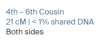
If I remember rightly from when the explanatory information was still available (ie yesterday evening) a match is shown as both sides if there are at least two DNA segments from each side. Since you're likely to share 35-40 segments with a 1st cousin the 95% accuracy claimed for SideView comes into play - 5% of 40 is 2.I think that this will become very useful when the bugs are ironed out but at the moment I am somewhat confused as it is saying that my maternal 1st cousin is "both sides".
So far I have found no crossover families that could indicate this and I have gone way back on most lines. My maternal side is Staffordshire and surrounding area while my paternal side is Co Durham / N Yorkshire which, to me, looks like the two were not likely to meet. Admittedly there are a few "unknown" fathers on each side but for this to be the answer would be a big coincidence.
If anyone can explain this to me I would be pleased to hear the reasoning.

If I remember rightly from when the explanatory information was still available (ie yesterday evening) a match is shown as both sides if there are at least two DNA segments from each side. Since you're likely to share 35-40 segments with a 1st cousin the 95% accuracy claimed for SideView comes into play - 5% of 40 is 2.
5% of 33 is 1.65, which means it's quite feasible that 2 segments were allocated to the wrong parent.If it helps, my match with my cousin says 15% shared: 1033 cM across 33 segments.
5% of 33 is 1.65, which means it's quite feasible that 2 segments were allocated to the wrong parent.

It'll be a long wait. This high level of accuracy is only achievable because they have over 23 million tests in their database - for a significant improvement in accuracy they'd probably have to sell at least 10 million more tests.Thanks again - I will keep an eye on this to see if the accuracy improves

My husband had one English parent and one Welsh parent, but he still has 6,335 unassigned matches, more than either English Parent 1 (6,209) or Welsh Parent 2 (6,185), so 33% unassigned. Both my parents were English but I have a similar proportion (32%) of unassigned matches (7,497 unassigned, 15,835 assigned).For example, my mother-in-law, who had one English parent, and one Welsh parent, has very few unassigned matches - about a tenth as many as most of the other tests I manage.
I also have my maternal first cousin listed as 'both sides'. They are the only match of mine that is listed as 'both sides'. They are also my closest DNA match, which is unsurprising since neither of us has any known closer relatives still alive. This fits with the explanation offered by Ancestry, via Peter, that with a lot of shared DNA there is increased likelihood that some of it falls into the 5% of erroneous allocation. However, I also know from another site that both mine and my cousin's DNA has been uploaded to that my maternal cousin does indeed share a small amount of DNA with someone who is a match on my paternal side. I think that might possibly be because they both have a lot of Irish ancestry (although I don't - my maternal cousin gets theirs from their parent that is only related to me by marriage and I get the small amount I do have from my paternal side) so there's quite a lot of scope for them having some distant connection?I think that this will become very useful when the bugs are ironed out but at the moment I am somewhat confused as it is saying that my maternal 1st cousin is "both sides".
So far I have found no crossover families that could indicate this and I have gone way back on most lines. My maternal side is Staffordshire and surrounding area while my paternal side is Co Durham / N Yorkshire which, to me, looks like the two were not likely to meet. Admittedly there are a few "unknown" fathers on each side but for this to be the answer would be a big coincidence.
If anyone can explain this to me I would be pleased to hear the reasoning.
That's my interpretation of what I know about how Ancestry classify a cousin as unassigned - they wouldn't necessarily agree with what I've said.the explanation offered by Ancestry, via Peter, that with a lot of shared DNA there is increased likelihood that some of it falls into the 5% of erroneous allocation
Most distant connections involve a single shared segment of DNA, not two segments. So it's very likely that at least one of the segments has been wrongly allocated. Even if one of the segments has been inherited on your father's side, if it's a result of his Irish ancestry it's unlikely to be meaningful.However, I also know from another site that both mine and my cousin's DNA has been uploaded to that my maternal cousin does indeed share a small amount of DNA with someone who is a match on my paternal side. I think that might possibly be because they both have a lot of Irish ancestry (although I don't - my maternal cousin gets theirs from their parent that is only related to me by marriage and I get the small amount I do have from my paternal side) so there's quite a lot of scope for them having some distant connection?


That's my interpretation of what I know about how Ancestry classify a cousin as unassigned - they wouldn't necessarily agree with what I've said.