-
Only registered members can see all the forums - if you've received an invitation to join (it'll be on your My Summary page) please register NOW!
-
It's easier than ever before to check your entries from the 1881 Census - more details here
You are using an out of date browser. It may not display this or other websites correctly.
You should upgrade or use an alternative browser.
You should upgrade or use an alternative browser.
AncestryDNA’s new BETA
- Thread starter jorghes
- Start date

KC4
LostCousins Member
Might seem rather obvious but did you turn on the 'Common ancestors' in the 'Add a filter' drop down menu?
It is "on" by default in my case........and the "answer" is "No matches match the selected filter."

jorghes
LostCousins Superstar
It is "on" by default in my case........and the "answer" is "No matches match the selected filter."
That seems strange.
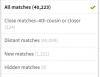
Have you noticed that Ancestry Now tell you how many matches you now have?
View attachment 1547
How about that... But no, I hadn’t noticed. It also will tell you how many matches you have put in each group.
So far the most interesting thing about that - other than that my grandmother’s results garner over 74,000 results, is that on my own list, while I have in the region of 30,000 matches, less than 100 of each are also matched to my mother or father... And on my father’s results (he also has in the region of 30,000 matches, only 128 match his mother’s results)

Isn't that because Ancestry only show shared matches where it is a close match for both? Thus the total number of matches you share with both parents can't exceed the number of close matches you have (which is usually just under 1% of the total, so under 300 in your case).So far the most interesting thing about that - other than that my grandmother’s results garner over 74,000 results, is that on my own list, while I have in the region of 30,000 matches, less than 100 of each are also matched to my mother or father... And on my father’s results (he also has in the region of 30,000 matches, only 128 match his mother’s results)
jorghes
LostCousins Superstar
Isn't that because Ancestry only show shared matches where it is a close match for both? Thus the total number of matches you share with both parents can't exceed the number of close matches you have (which is usually just under 1% of the total, so under 300 in your case).
Highly possible - remembering that people only come up as “shared matches” if they are counted as “3rd cousins or closer” to both people (I think), so presumably this runs on the same sort of criteria, thus making sure the matches it’s suggesting are as concrete as they can?

Pauline
LostCousins Megastar
I think it's actually the "4th cousins & closer"category. I can understand why, but sometimes it would be useful to know about the shared matches in the "distant cousins" category. I guess that is where ThruLines can make things a bit clearer, but I would probably have recognised more connections some time ago if distant cousins had showed up as shared matches.people only come up as “shared matches” if they are counted as “3rd cousins or closer” to both people (I think)
Perhaps Ancestry carried out an experiment along the lines of the feature that MyHeritage have recently added, and realised that by relaxing the constraints too far they would risk creating creating pools of false matches? It's a common problem at GEDmatch (where you have full control over the parameters) and also at FTDNA.

Helen7
LostCousins Superstar
Have you noticed that Ancestry Now tell you how many matches you now have?
Yes, seeing the number of matches in each category is very useful, and I also notice that the matches are displayed in one continuous list and not split into pages of 50 per page.It also will tell you how many matches you have put in each group.
Oddly, I now find that my match list is not displaying properly in Firefox on my Mac (only first 20 matches shown, and linked tree/common ancestor column is blank), though Chrome and Safari both work fine.
Helen7
LostCousins Superstar
I agree. ThruLines has shown me connections that did not show up in Shared Matches, due to the 20 cM cutoff. The cutoff is of course rather arbitrary in terms of distance of relationship. I have 'distant' matches of <20 cM where the relationship is actually closer than some in the 30-60 cM bracket, but I suppose it's just the luck of the draw. Probably a line has to be drawn somewhere to avoid lots of false matches coming up. With ThruLines, there is clearly no cutoff in the DNA matches shown, so you need to investigate whether the match is real or not.I think it's actually the "4th cousins & closer"category. I can understand why, but sometimes it would be useful to know about the shared matches in the "distant cousins" category. I guess that is where ThruLines can make things a bit clearer, but I would probably have recognised more connections some time ago if distant cousins had showed up as shared matches.
jorghes
LostCousins Superstar
Another note about ThruLines and the New and Improved DNA matches - they rely on someone linking their results to their tree, unsurprisingly. I was checking though shared matches (I do like the new way they do that, so I can add the shared matches to groups rather than having rather tediously to add notes to them) and found a person who should appear on ThruLines (it’s very easy to see where our trees intersect - the names are very clear) but he hasn’t linked his DNA to his tree and thus the easy results and links are passing him by!
Helen7
LostCousins Superstar
Good point. The person I mentioned earlier (post #25) as appearing in my ThruLines despite him having no tree was not strictly correct. He does have a linked 'tree' containing just one person - himself - but that is enough for Ancestry to find his parents, grandparents, great-grandparents and gg-grandparents via other people's public trees and show them to me via ThruLines. And everything checks out with the BMD records, so I am confident that it's all correct and he is my 4th cousin (at 65 cM shared DNA I knew we would be related but until ThruLines I didn't know how). I presume he would also see our link via ThruLines if he logged in.Another note about ThruLines and the New and Improved DNA matches - they rely on someone linking their results to their tree, unsurprisingly.
And of course, as you say, those with unlinked trees or no tree will not show up in ThruLines, but will show up in shared matches, so another angle to explore. I agree, the 'groups' feature is useful, though I do also tend to add a note to each person identifying the specific link where I have identified it.
jorghes
LostCousins Superstar
Good point. The person I mentioned earlier (post #25) as appearing in my ThruLines despite him having no tree was not strictly correct. He does have a linked 'tree' containing just one person - himself - but that is enough for Ancestry to find his parents, grandparents, great-grandparents and gg-grandparents via other people's public trees and show them to me via ThruLines. And everything checks out with the BMD records, so I am confident that it's all correct and he is my 4th cousin (at 65 cM shared DNA I knew we would be related but until ThruLines I didn't know how). I presume he would also see our link via ThruLines if he logged in.
And of course, as you say, those with unlinked trees or no tree will not show up in ThruLines, but will show up in shared matches, so another angle to explore. I agree, the 'groups' feature is useful, though I do also tend to add a note to each person identifying the specific link where I have identified it.
That example does show how much research Ancestry is allowing us to bypass to link people.
Unfortunately a couple of my suggested links seem completely wrong - they also double up, mostly because the ancestors they’re suggesting were born and died in the US, while the ancestor they’re supposed to be a parent of was born and died in England.

JimP
LostCousins Member
The "substituted ancestor" is the worst part of ThruLines. I find it annoying, but I just ignore them. But for inexperienced researchers, these substitutes can lead them in all sorts of wrong directions (I am watching my husband do this -- he had one where the ancestor in his tree was replaced by someone else, on the wrong continent, and he was all set to merge that person into the ancestor in his tree)
Personally, I have found it very helpful. When my DNA results came back, I had a bunch of predicted 2d to 4th cousins, all matches to one another, that were a complete mystery to me. I had no common ancestors, or even common surnames, in any of their public trees. From geographical indicators (18th c European immigrants to mid-Atlantic states), they had to be on my mother's side. My mother, her mother, and both paternal grandparents and her maternal grandfather were only children, or the only child to have issue, so the pool of potential cousins, especially as close as a 2d cousin, is very small.
Using ThruLines, I went through each great-great-grandparent or 3d-great-grandparent on my maternal side (depending on where collateral lines would be expected), looking at matches to that ancestor. There were no matches connected to 3d-g-grandparents Patrick and Ellen Boyle, Irish immigrants with 10 children. All the other lines had connections, all of whom I could identify as cousins I have previously been in touch with on those lines, or whom I had identified in my research. The likely conclusion: Charles Boyle, my grandmother's father according to her birth certificate, was not her biological father. (This was not entirely a surprise, as Charles and his wife Myrtle separated not long after my grandmother's birth, though the story passed down by my grandmother was that his Catholic family had never accepted his marriage to a Protestant, and he decided to return to the fold).
Step 2 was to look at the trees of this group of possible cousins. The common element was an Ash family, several members of which lived in the same area as Charles and Myrtle at the time in question.
The next step will be to analyze those trees more closely, to try to determine which of the Ash sons was the likely father.
Without ThruLines, I would have would have done the same analysis of those trees, and come up with the individual who was the likely connection, but I would not have so readily connected him to my grandmother.
Personally, I have found it very helpful. When my DNA results came back, I had a bunch of predicted 2d to 4th cousins, all matches to one another, that were a complete mystery to me. I had no common ancestors, or even common surnames, in any of their public trees. From geographical indicators (18th c European immigrants to mid-Atlantic states), they had to be on my mother's side. My mother, her mother, and both paternal grandparents and her maternal grandfather were only children, or the only child to have issue, so the pool of potential cousins, especially as close as a 2d cousin, is very small.
Using ThruLines, I went through each great-great-grandparent or 3d-great-grandparent on my maternal side (depending on where collateral lines would be expected), looking at matches to that ancestor. There were no matches connected to 3d-g-grandparents Patrick and Ellen Boyle, Irish immigrants with 10 children. All the other lines had connections, all of whom I could identify as cousins I have previously been in touch with on those lines, or whom I had identified in my research. The likely conclusion: Charles Boyle, my grandmother's father according to her birth certificate, was not her biological father. (This was not entirely a surprise, as Charles and his wife Myrtle separated not long after my grandmother's birth, though the story passed down by my grandmother was that his Catholic family had never accepted his marriage to a Protestant, and he decided to return to the fold).
Step 2 was to look at the trees of this group of possible cousins. The common element was an Ash family, several members of which lived in the same area as Charles and Myrtle at the time in question.
The next step will be to analyze those trees more closely, to try to determine which of the Ash sons was the likely father.
Without ThruLines, I would have would have done the same analysis of those trees, and come up with the individual who was the likely connection, but I would not have so readily connected him to my grandmother.
Pauline
LostCousins Megastar
On this, I mentioned in #8 of this thread that ThruLines had incorrectly redefined my husband and his brother as half-brothers. Since he has been busy with other things, I had a look at this myself yesterday and realised this was because someone else had been substituted for their mother in his brother's ThruLines.The "substituted ancestor" is the worst part of ThruLines. I find it annoying, but I just ignore them
Anyone reading this thread may just have noticed that I am not overly impressed with the way ThruLines has displaced a number of my ancestors - probably because of all the time and care I have invested in my research over the past 30 years. However, even if ThruLines needs to do this to work more effectively overall, surely people's near ancestors - people they will have known personally - should somehow be ring-fenced?
I find it rather puzzling anyway - my husband and his brother are both linked to the same tree, so why does ThruLines make a change like this for one of them but not the other?
Helen7
LostCousins Superstar
Sorting through my new ThruLines connections, I have so far only found one that is clearly wrong, but it illustrates (I think) another situation where ancestor substitution can be very misleading.Unfortunately a couple of my suggested links seem completely wrong
In this case, I am matched with Gloria and our 'common ancestor' is just shown as 'private' (call her A) and Gloria is shown as descended from another 'private' person (B, being A's son), who is supposedly the brother of my 3x g-grandfather. But looking at Gloria's tree, she has a different person for B, with a different surname to my ancestor (though from the same town). It looks like Ancestry has substituted another person from a private tree for Gloria's genuine ancestor, thus making the false connection.
Helen7
LostCousins Superstar
I totally agree. They should accept people in your tree, at least back to grandparents. In fact, I really don't see why they should be substituting ancestors at all. Fair enough to give you hints on ancestors going further back than you have reached, but I can't really see the point of replacing ancestors already in your tree. Maybe I'm missing something here, but I can't see the benefit to anyone, unless their tree is full of speculative ancestors and they need Ancestry to show them where they've gone wrong, in which case there could be an option to replace existing ancestors with 'potential' hints if desired.However, even if ThruLines needs to do this to work more effectively overall, surely people's near ancestors - people they will have known personally - should somehow be ring-fenced?
I hope Ancestry take notice of the feedback we are sending them.
Last edited:

I think maybe sustituting is the wrong word to use here? Ancestry are not changing your tree. What they are doing with ThruLines is showing you suggestions, which is comparable to Hints on their Family Tree side.
Just like with any other hint, you look at it and evaluate it and if correct then you can add the facts. The one thing that they are missing is the ability to press Ignore on a suggestion that is incorrect.
Just like with any other hint, you look at it and evaluate it and if correct then you can add the facts. The one thing that they are missing is the ability to press Ignore on a suggestion that is incorrect.
Helen7
LostCousins Superstar
I get what you are saying, and of course Ancestry aren't changing your tree. However, they are imposing the 'substitute' into your ThruLines analysis, which stops you seeing matches descended from your genuine ancestors, as Pauline mentioned in #56.I think maybe sustituting is the wrong word to use here? Ancestry are not changing your tree. What they are doing with ThruLines is showing you suggestions, which is comparable to Hints on their Family Tree side.
Just like with any other hint, you look at it and evaluate it and if correct then you can add the facts. The one thing that they are missing is the ability to press Ignore on a suggestion that is incorrect.
If they included an 'Ignore' button on the 'potential ancestor' tile that allowed you to go back to displaying your actual ancestor, that would be good. If they also indicated that the 'potential ancestor' was there in place of an ancestor in your tree, it would be even better.

Bob Spiers
LostCousins Superstar
Yes, that is indeed the crux of the whole thing, and an 'Ignore' option has to be the answer. It works with Tree hints - although not, sadly, with Ancestry Member Tree Hints (some of which are plain farcical) and which I have always argued should also include an 'Ignore' option - and the same should apply to ThruLine suggestions.Just like with any other hint, you look at it and evaluate it and if correct then you can add the facts. The one thing that they are missing is the ability to press Ignore on a suggestion that is incorrect.
Tim is right, Ancestry are merely offering suggestions and however weird we deem some of them to be, some may open up new research avenues. Like all suggestions, they are there to be appraised, acted upon or ignored. But so much better to have the formal option to Ignore.