• Only registered members can see all the forums - if you've received an invitation to join (it'll be on your My Summary page) please register NOW!

  • If you're looking for the LostCousins site please click the logo in the top left corner - these forums are for existing LostCousins members only.
  • This is the LostCousins Forum. If you were looking for the LostCousins website simply click the logo at the top left.
  • It's easier than ever before to check your entries from the 1881 Census - more details here

Nuts and Bolts family reconstitution question

whitebullwifezig

LostCousins Member
Hi,

I've got the second edition of Nuts and Bolts by Andrew Todd. It was an excellent read and gave me lots of new ideas. I noticed some of it seemed outdated and then saw there's a 3rd edition. Should I upgrade to the 3rd edition? My own version of family reconstitution is done via the GRO index (which at time of writing that book, I don't think was online?)

(the ethos fits well with lost cousins - breaking down brick walls by finding out everything you possibly can about collateral lines)
 
Family reconstitution, as a means of identifying our ancestors, is mainly relevant to the pre-1837 period - because often the only information available comes from parish registers, which we know to be an incomplete and sometimes unreliable source (especially when there are non-conformists in the family). But from 1841 onwards there are both and civil registration records, so there is less likely to be uncertainty about our ancestors - other than in cases of illegitimacy and adoption.

Of course, researching collateral lines is key to finding 'lost cousins', so keep going - but I can't see how a new edition of the book is going to make it any easier.
 
parish registers, which we know to be an incomplete and sometimes unreliable source (especially when there are non-conformists in the family)

When you say especially non=conformist ones are unreliable, do you mean it's more likely that the record isn't there, or that what it contains is likely to be less reliable?
The presence or absence of the records I can't comment on, because I've done very little searching of such records; their content, however - on the odd occasion when I have used them, I've found them a pleasure compared to Anglican records - baptisms and marriages, at least, contain so much more information than their Anglican counterparts. And I've not found them - where I've been able to verify from other sources - any less reliable in what they tell me; granted, since there is so much more information, there is more chance for error, but I'd rather have the extra!
 
When you say especially non-conformist ones are unreliable, do you mean it's more likely that the record isn't there, or that what it contains is likely to be less reliable?
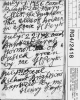
It's more likely that non-conformist records haven't survived, especially before the mid-18th century - and those that have survived could be no more than notebooks with scribbled information (more like a sexton's notebook than a register). When my 4GGF was baptised in 1756 there were no names given for his parents.

upload_2025-10-2_11-6-35.png

There is the added problem that Baptists did not believe in the baptism of infants and, unlike Quakers, they did not usually record births.
 
I see what you mean! I guess I haven't found any Baptists in my tree or those I've done for others. Catholic and Scottish records, in contrast, have a lovely lot of detail, as do some others (I forget what) I've encountere.
 
Catholic and Scottish records, in contrast, have a lovely lot of detail
Catholic records vary in the level of detail. Many give the names of sponsors (who may or may not be related), some give the mother's maiden name, relatively few that I've seen give the address of the family.

As for Scottish parish registers, here's what ScotlandsPeople say:

The amount of information recorded can be variable and most entries contain very little detail. At best: name of the child, date of birth and/or date of baptism, father's name, mother's name and maiden surname, place or parish of residence, occupation of the father and names (and sometimes occupations) of witnesses. Very occasionally the witnesses' relationships to the child may be recorded. At worst: the mother's name is not recorded at all between certain years or that the entry does not record the sex of the child and the name is ambiguous.

I understand that the survival rate is poor.
 
I guess my perception of what's in Scottish records is swayed by not having seen many of them, due to them only (in effect) being available as pay-per-view. The one I'm thinking of, which for some reason I do have (maybe a relative shared it with me?), the 1940-11-12 marriage of Robert Kennedy to Margaret Sweeten, in Shettleston, Glasgow, shows: name. age. address, signature, and profession of both; name and profession of both fathers; and name and maiden surname of both mothers. (Obviously what I have is a transcription, as all handwriting including the "signatures" is the same.) I have another from 1888 which seems to use the same form and thus the same details.
Similarly for the Catholic ones; I can't find an example at the moment, but I remember the form - printed, with bits in Latin - had spaces for quite a lot of information. Yes, it did contain spaces for godparents, of course, if a baptism. Of course, before printed forms, I guess we're in the same region as the Anglicans - more or less what the clerk wanted to record.
USA records are enviably comprehensive, at least the preprinted cards. As are Australian forms.
 
I guess my perception of what's in Scottish records is swayed by not having seen many of them, due to them only (in effect) being available as pay-per-view. The one I'm thinking of, which for some reason I do have (maybe a relative shared it with me?), the 1940-11-12 marriage of Robert Kennedy to Margaret Sweeten, in Shettleston, Glasgow, shows: name. age. address, signature, and profession of both; name and profession of both fathers; and name and maiden surname of both mothers. (Obviously what I have is a transcription, as all handwriting including the "signatures" is the same.) I have another from 1888 which seems to use the same form and thus the same details.
It sounds to me as if you're talking about civil records: civil registration began in Scotland in 1855, and although the level of details varies it's almost always more than you'd find in the equivalent records for England & Wales.
 
Yes, civil records for Scotland. Church ones for Catholic though - though not too far back, as it was a printed form - although in Latin. (Well within the capabilities of Latin O level, though.) And civil ones for USA, which are pretty good - even the marriage ones have both mothers' maiden names, and the birth an death ones have lots (though not very carefully checked, but at least they're there!).
 
Church ones for Catholic though - though not too far back, as it was a printed form - although in Latin.
As I mentioned earlier, Catholic registers vary enormously in the amount of information that's shown.
And civil ones for USA, which are pretty good - even the marriage ones have both mothers' maiden names, and the birth and death ones have lots (though not very carefully checked, but at least they're there!).
Vital records in the US vary according to time period and state - and even within states. See this overview at FamilySearch.

Finally, a reminder that this discussion is about family reconstitution, which is a technique that is rarely necessary after the commencement of civil registration (and censuses).
 
Family reconstitution, as a means of identifying our ancestors, is mainly relevant to the pre-1837 period - because often the only information available comes from parish registers, which we know to be an incomplete and sometimes unreliable source (especially when there are non-conformists in the family). But from 1841 onwards there are both and civil registration records, so there is less likely to be uncertainty about our ancestors - other than in cases of illegitimacy and adoption.

Of course, researching collateral lines is key to finding 'lost cousins', so keep going - but I can't see how a new edition of the book is going to make it any easier.

I’d argue family reconstitution is a core method for any period especially if you have family with common names or who are living in large parishes. Civil registration and censuses certainly add precision, but they don’t eliminate uncertainty. Identifying siblings and collateral lines is often what allows you to prove which John Smith or Mary Brown belongs to your tree.

I’ve found it invaluable to reconstitute whole families. For example, I’ve mapped out every Boyns birth in England and Wales, which means whenever I come across a stray entry in the probate calendars, newspapers, or even military records, I can usually place the individual immediately. Without that broader reconstruction, those “floating” references would stay unresolved.

It’s also worth noting that illegitimacy, remarriage, step-families, name variations, and migration still complicate matters post-1837. That’s precisely where family reconstitution pays off: cross-checking every sibling, marriage, and burial builds a net tight enough to catch people who’d otherwise be lost. Not to mention if you have Jewish ancestry and can't access the synagogue records.

In short, the method isn’t made redundant by better records – it’s what makes those better records yield their full value.
 
I guess my perception of what's in Scottish records is swayed by not having seen many of them, due to them only (in effect) being available as pay-per-view. The one I'm thinking of, which for some reason I do have (maybe a relative shared it with me?), the 1940-11-12 marriage of Robert Kennedy to Margaret Sweeten, in Shettleston, Glasgow, shows: name. age. address, signature, and profession of both; name and profession of both fathers; and name and maiden surname of both mothers. (Obviously what I have is a transcription, as all handwriting including the "signatures" is the same.) I have another from 1888 which seems to use the same form and thus the same details.
Similarly for the Catholic ones; I can't find an example at the moment, but I remember the form - printed, with bits in Latin - had spaces for quite a lot of information. Yes, it did contain spaces for godparents, of course, if a baptism. Of course, before printed forms, I guess we're in the same region as the Anglicans - more or less what the clerk wanted to record.
USA records are enviably comprehensive, at least the preprinted cards. As are Australian forms.

I love seeing the Scottish records. Some Australian ones are very bare bones though - I've seen marriage registers that look just like ours, but don't have any section on the fathers... Each territory has their own way of doing things, I think.
I was led very astray by my grandfather's death certificate. I’ve got some Scottish DNA. A Scottish name, died in Scotland, and a name and profession for his dad - bingo (or so I thought). Spent ages looking for him in the Scotland birth index. The name is false, he was not Scottish at all, and he was in Scotland because he was in a sanatorium (no idea why he wasn’t in a sanatorium closer to home). Whilst we are on the topic of Catholic baptism, I happen to have my grandfather's baptism, too. It was fascinating and again has a fake name for his dad. It wasn't until I was browsing some unindexed images on Familysearch that I saw he shortly afterwards attended a RC primary school!
 
I’d argue family reconstitution is a core method for any period especially if you have family with common names or who are living in large parishes. Civil registration and censuses certainly add precision, but they don’t eliminate uncertainty. Identifying siblings and collateral lines is often what allows you to prove which John Smith or Mary Brown belongs to your tree.
As LostCousins members we always research our collateral lines in the 19th century - so you could say that it's a core method for us.

But it's not something that the average family historian needs to do routinely, as there are likely to be very few occasions when the information from BMD certificates and censuses is insufficient.
 
There is the added problem that Baptists did not believe in the baptism of infants and, unlike Quakers, they did not usually record births.

Not all Baptists - I have some in my tree (from a Baptist Church in Ely) and most of their children managed to have their births listed (this includes my 4x great grandfather, whose birth was recorded from 7 July 1789). Unfortunately the records themselves sometimes seem to be missing.

I love seeing the Scottish records. Some Australian ones are very bare bones though - I've seen marriage registers that look just like ours, but don't have any section on the fathers... Each territory has their own way of doing things, I think.

Most Australian records have both parents listed on birth, marriage and death records, including a mother's maiden name. The ones without the names of both parents are the exception rather than the rule. Graham Jaunay's website has a good guide about which of the records are missing which bits of information from which state. Generally I have found Australian records to be more detailed than Scottish records.
 
Back
Top